“Good artists borrow, great artists steal.”
“Good artists borrow, great artists steal.” —attributed to Pablo Picasso
From music to film to literature to fashion to painting, “stealing” inspiration has been happening for thousands of years, whether consciously or not. Some instances are subtle enough that audiences simply feel a sense of familiarity, while others are instantly recognizable.
Take Vanilla Ice’s song “Ice Ice Baby”, which was accused of stealing the bassline from Queen’s “Under Pressure”. Why “accused”? Because Vanilla Ice never admitted to plagiarizing the song, instead arguing that there were significant differences between his bassline and Queen’s. A more recent example is Lalisa’s “Like Jennie”, whose core beat sounds similar to a song performed by Indian actress and singer Alia Bhatt. The latter falls into the more subtle category, as it simply feels familiar.
Of course, when it comes to stealing inspiration, whether in the form of stories, music samples, or images, things are not quite that simple. By the mid-20th century, copyright regulations had become increasingly stringent. As a result, artists who were caught blatantly stealing inspiration, particularly in the music industry, could be required to pay copyright fees to the artists who created the original work.
In literature, however, the classic writing guide The Elements of Style (1999) by E.B. White and William Strunk actually encourages new writers who have yet to find their own voice or style to emulate the writing styles of their literary idols. The idea is to keep writing until they eventually uncover a style that feels comfortable and reflects their personality. “What makes it different than the others? YOU,” E.B. White boldly suggests.
FYI, even the Great Shakespeare was said to have frequently borrowed themes or storylines from other writers. So why is he still celebrated to this day? Because he was a truly gifted writer who could transform those influences into an authentic voice.
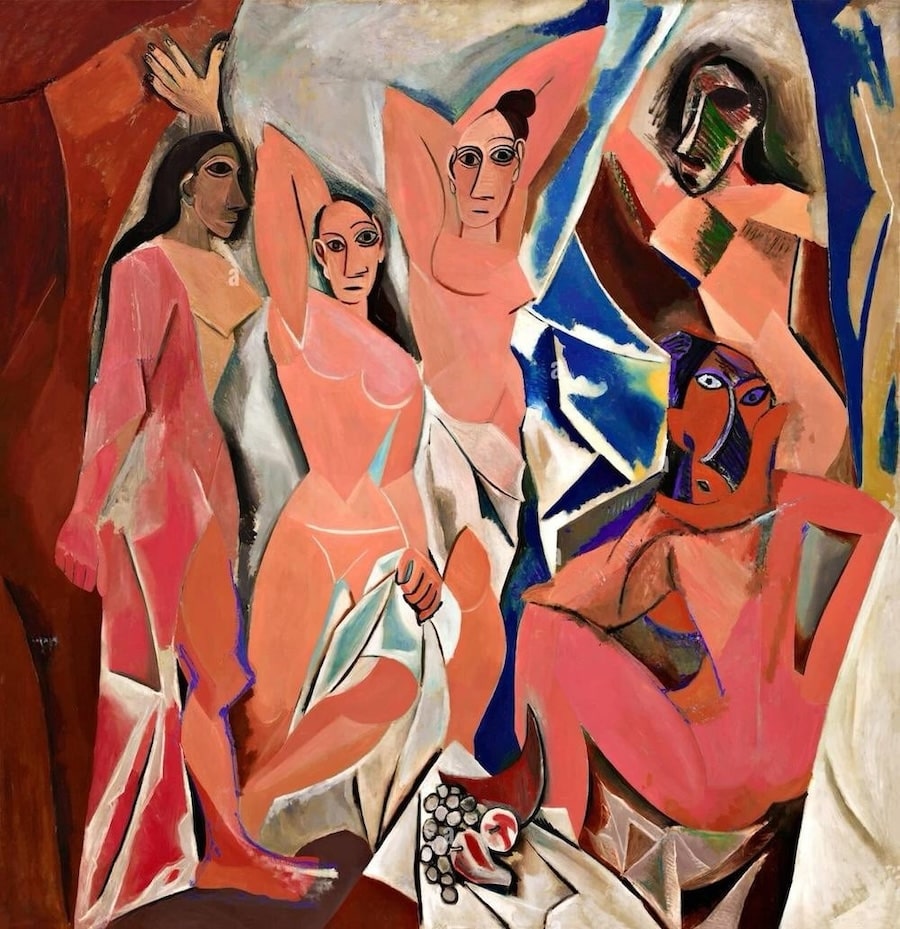 Pablo Picasso – Les Demoiselles d’Avignon, 1907
Foto: pablopicasso.org
In the visual arts, copyright regulations are difficult to enforce (especially in the age of Artificial Intelligence) because a painter or sculptor may simply take a form, brushwork, object, or theme and then combine it with elements that reflect their own personal style. Even Pablo Picasso was not immune to stealing inspiration. The pioneer of Cubism was accused of appropriating the style of French Cubist painter Georges Braque, whose influence can be seen in one of Picasso’s most renowned paintings, Les Demoiselles d’Avignon (1907). Ironically, Braque’s own style was influenced by the work of Paul Cezanne, who initially pioneered the Modernism movement in painting.
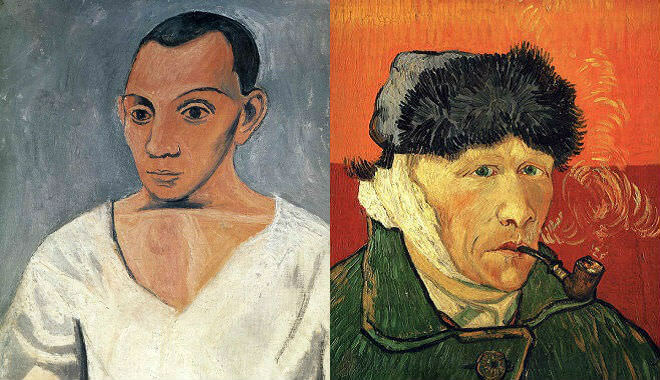
The list goes on and on. Vincent Van Gogh had a symbiotic relationship with Paul Gauguin. Although their creative partnership eventually fell apart, traces of their mutual influence remained in their later works. Van Gogh began to paint more subjects drawn from personal experience, much like Gauguin (who was associated with Impressionism and Symbolism), while Gauguin’s work, in turn, became increasingly filled with religious themes and vivid colors, particularly yellow, reminiscent of Van Gogh’s style.
So, the question remains: to steal is to honor? The answer, perhaps, can be framed in a positive light. What distinguishes a plagiarized work from an original one is the purity of the artist’s intention. An original work may contain elements of “stolen inspiration,” but what ultimately sets it apart is the artist’s authentic voice, seamlessly woven into the finished work.