Exploring The Maps of Meaning, a group exhibition featuring nine artists and their different perspectives on purpose, beliefs, and the ways we make sense of life’s journey.
From an early age, we are often introduced to an idea of life that seems to follow a fixed sequence: going to school, working, achieving success, and eventually finding happiness as we grow old. Without realizing it, this pattern gradually becomes a measure by which we view our own lives and those of others. We begin comparing achievements, questioning the direction of our lives, and even feeling left behind when our journey does not look like those around us.
But does everyone really have to follow the same path and pursue the same destination?
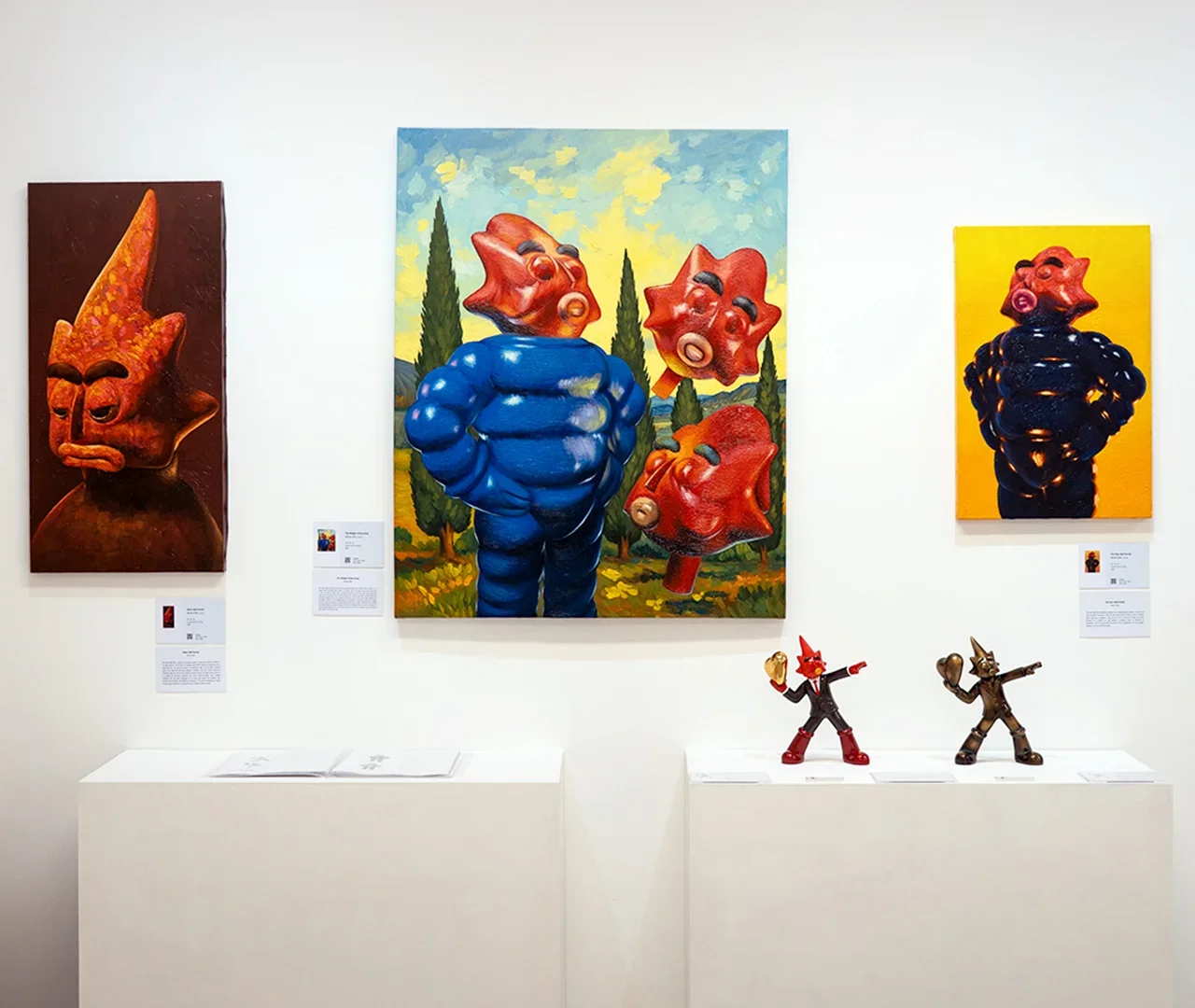
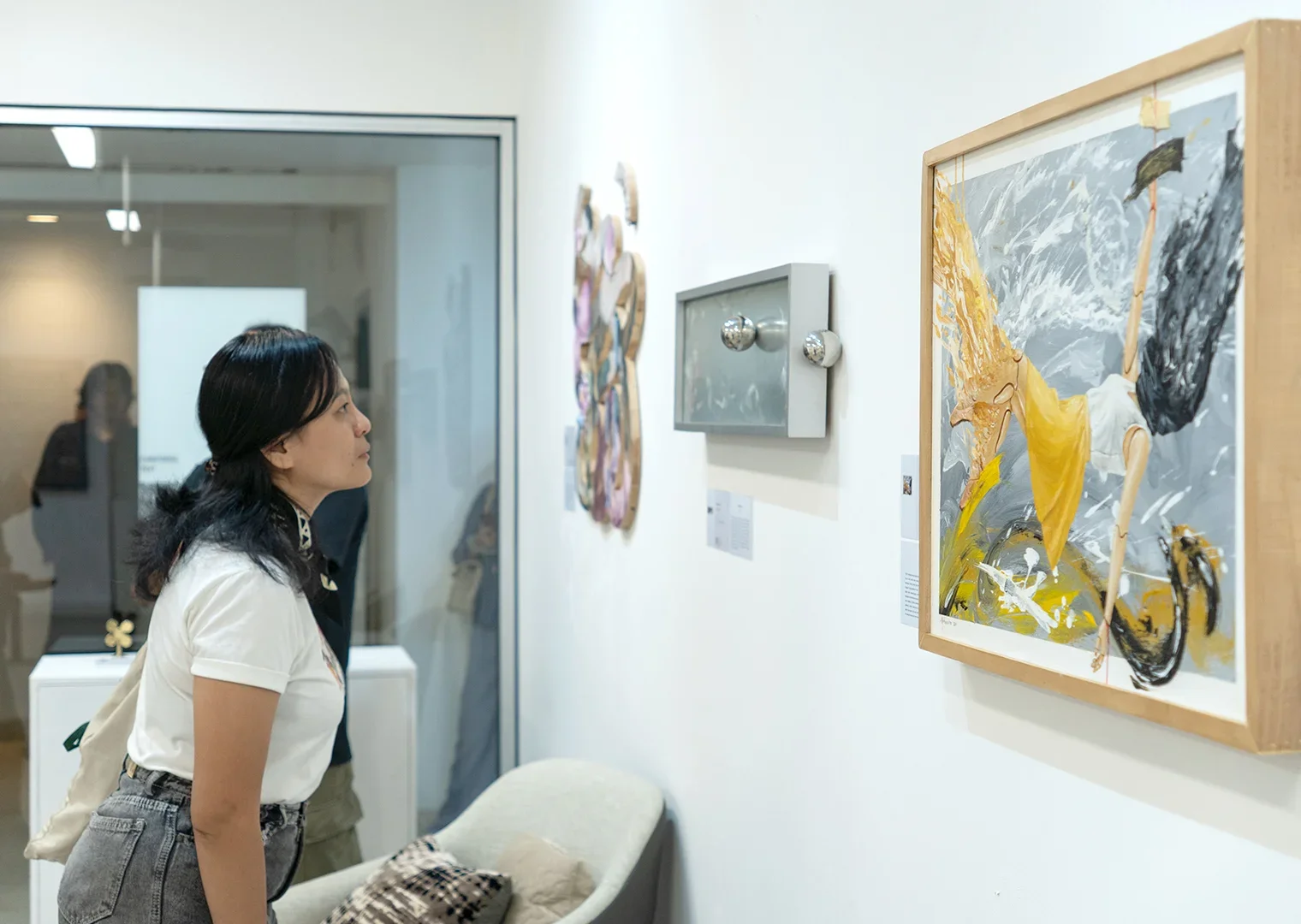
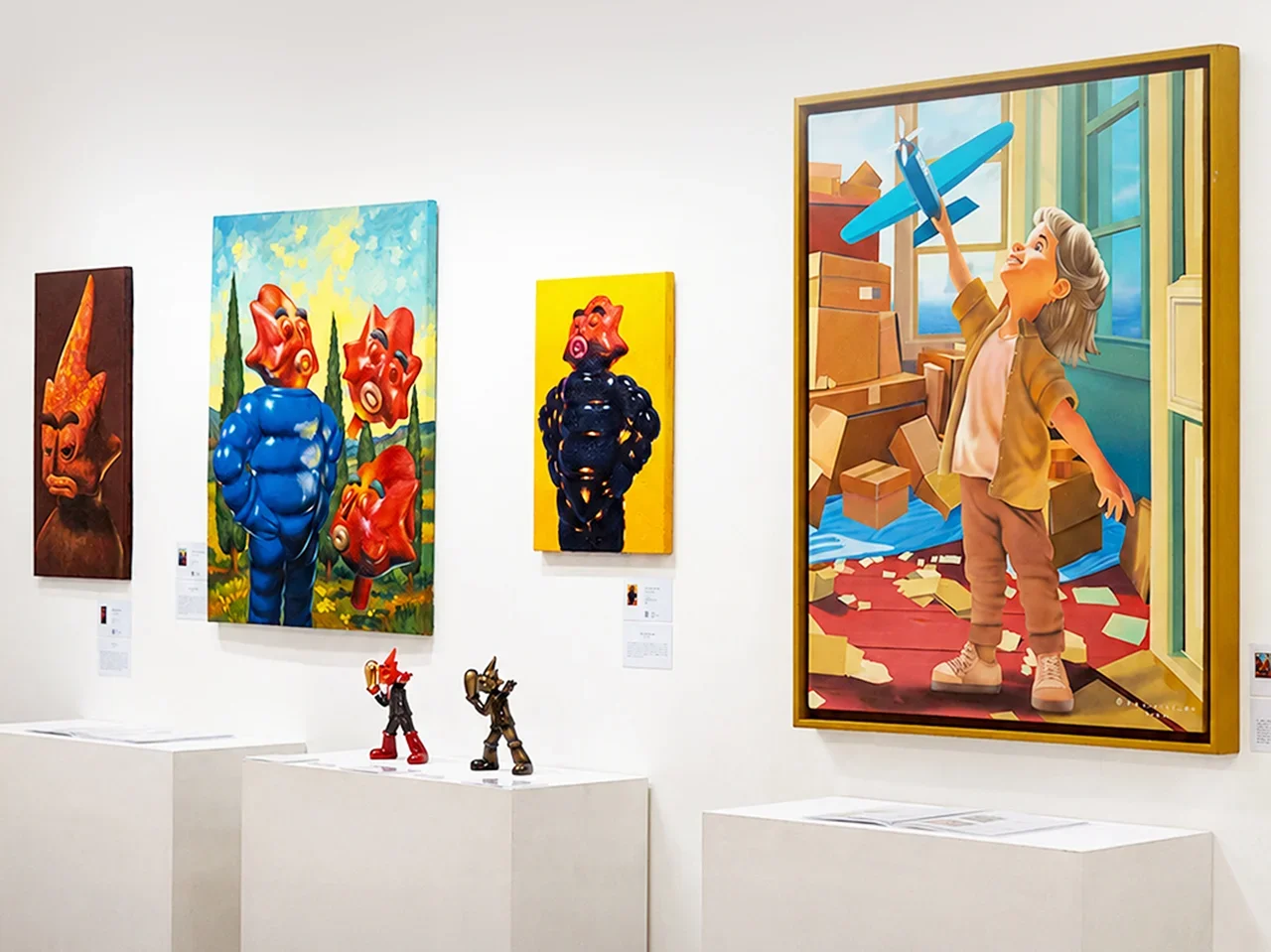
This question is explored from a different perspective in The Maps of Meaning, a group exhibition held at Meiro Gallery in Menteng, Central Jakarta, from July 11 to August 9, 2026. The exhibition brought together works by nine artists, each with distinct backgrounds and artistic practices. Rather than offering a single definition of how life should be lived, the works reveal the many ways people shape their goals, make sense of their experiences, and find their own direction in life.
The idea of a “map” in the exhibition does not represent a fixed route toward a particular destination. Instead, it serves as a metaphor for how each individual has their own set of coordinates, shaped by memories, beliefs, ambitions, experiences, and the way they see the world.
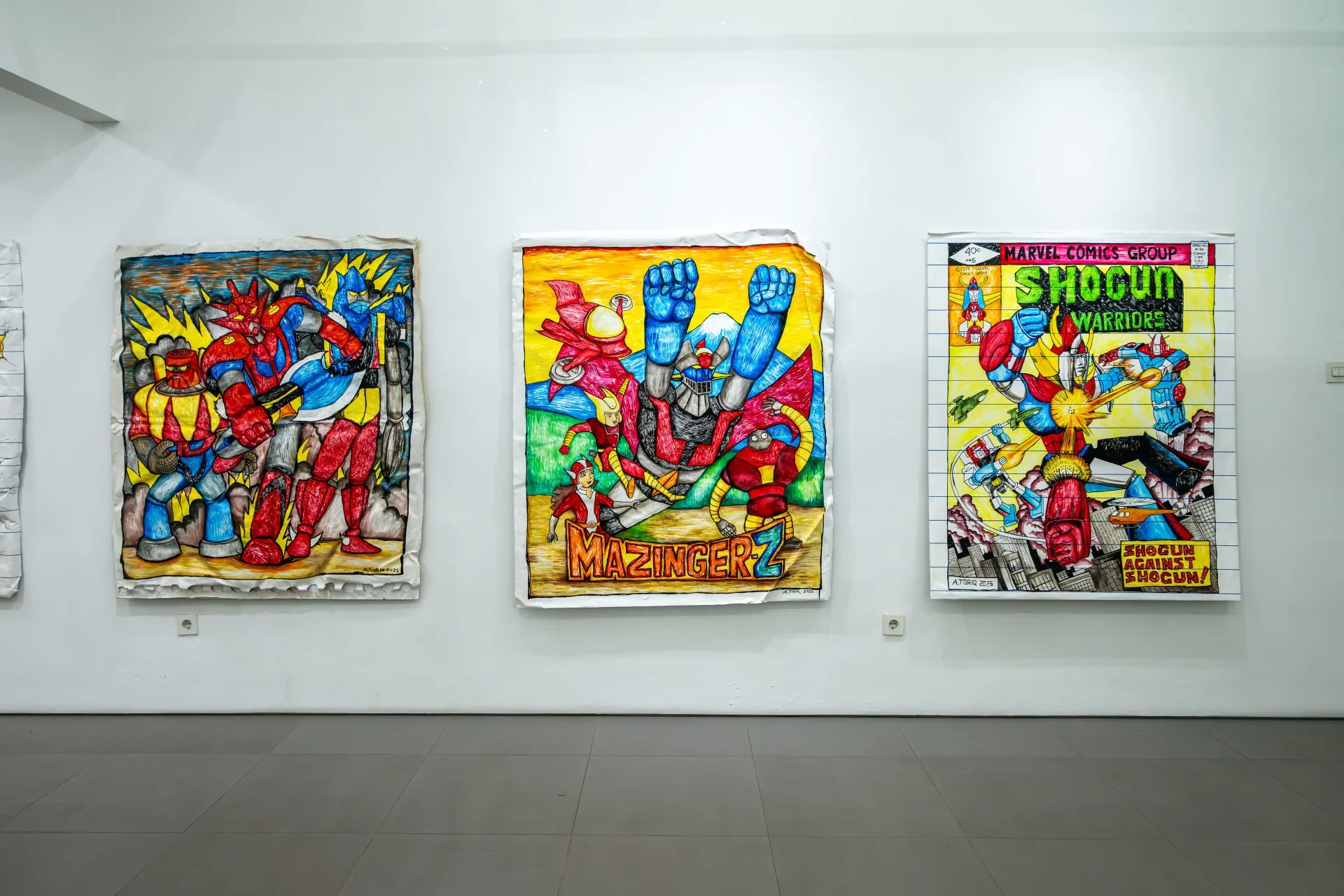
One perspective comes from Kreaby, a creative studio that provides a space for autistic artists. The characters presented in their works emerge from the artists’ experiences, imaginations, and ways of observing their surroundings. Their presence expands the exhibition’s central idea: differences are not only reflected in the goals people pursue, but also in the ways they understand the world from the very beginning. What may seem ordinary to one person can take on an entirely different form, story, and meaning to another.

Moving on to Ndikol’s work, the discussion of life goals shifts toward more material pursuits: wealth, status, and the desire for more. In Rich Guy Pointing Meme, Ndikol draws inspiration from a widely recognized internet meme and reinterprets it through his distinctive visual language. Several characters appear dressed in luxurious clothing, pointing at one another while wearing bandanas emblazoned with dollar signs over their faces.
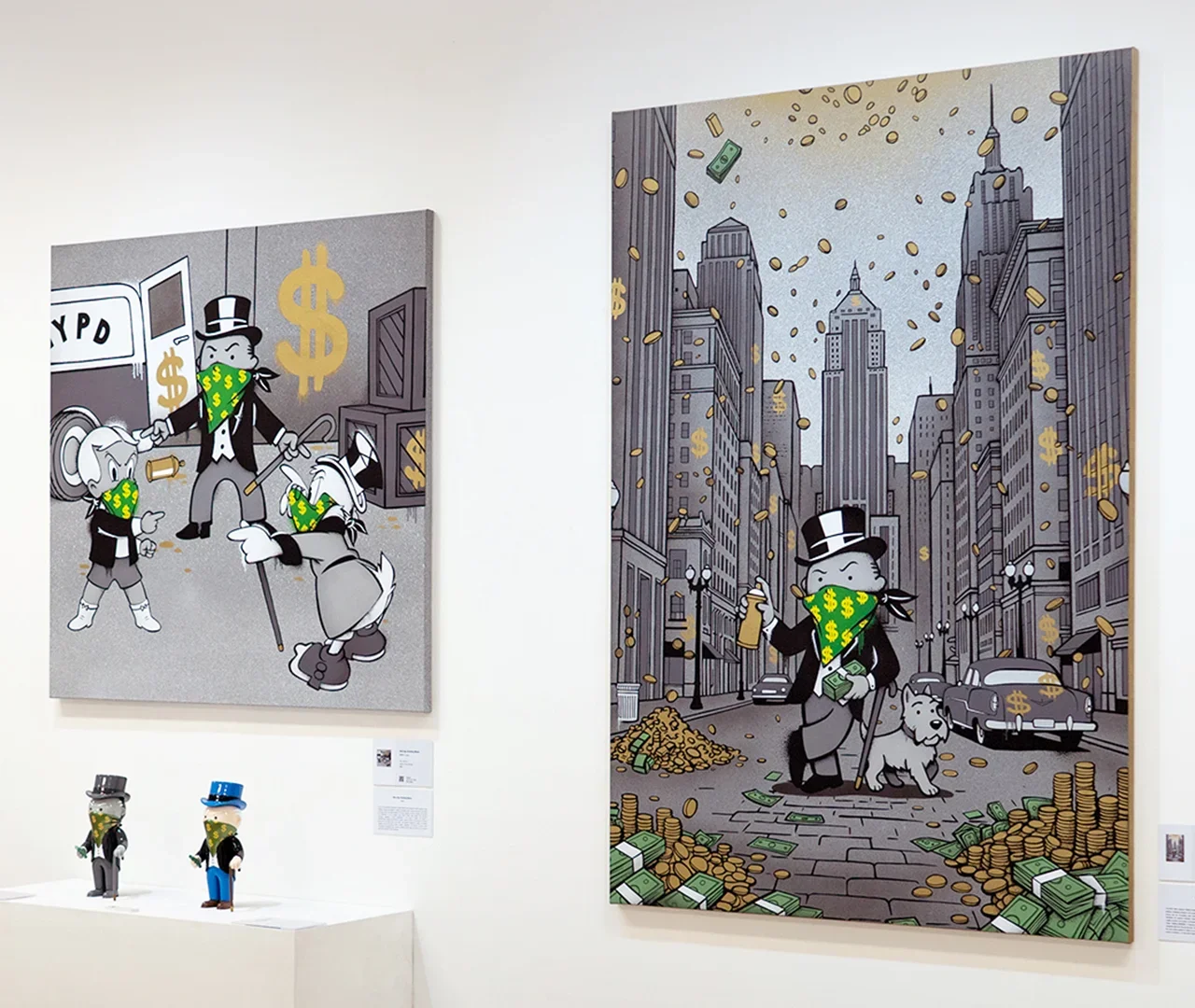
The scene feels like a simple joke, but carries a subtle critique of how people perceive wealth. The act of pointing at one another can be read as a depiction of competition, as well as the tendency to blame others in a race that never truly ends. Behind the characters, a black-and-white background filled with gold dollar signs creates a contrast that reinforces the themes of money and status. By combining meme culture, humor, popular culture, and a street art approach, Ndikol presents a critique of materialism that feels light on the surface, yet becomes sharper the longer it is observed.
Meanwhile, Arsita Pinandita’s work shifts the conversation toward a journey centered on an icon with a long-standing history. Here Hops the Sun features a rabbit character named Aka following in The Beatles’ footsteps at the iconic crosswalk in Liverpool. Aka’s presence is not intended to replace or erase the rich history associated with the site. Instead, it offers a new way of following in the footsteps of a legend while bringing that legacy into a different story.
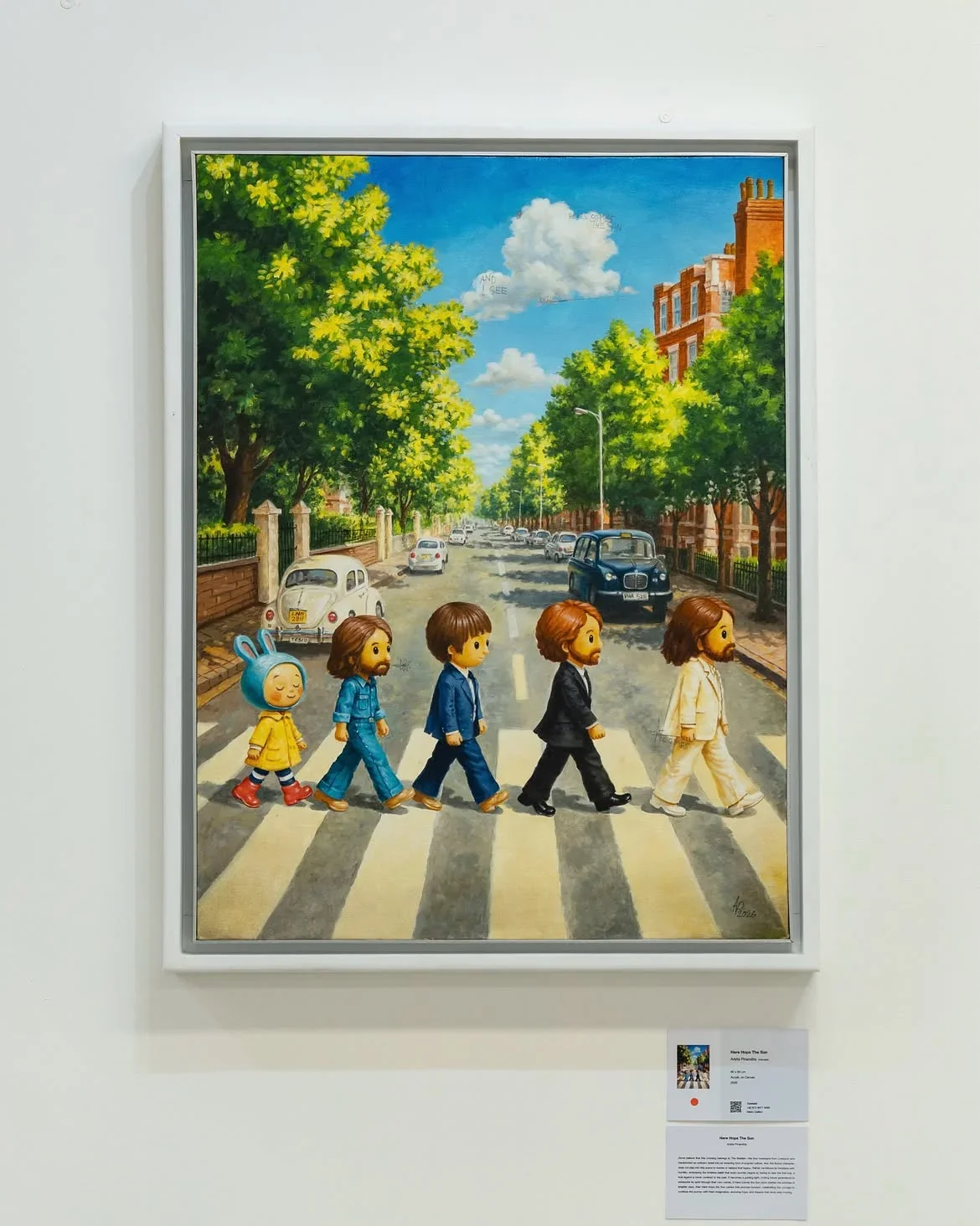
In this work, the idea of a journey becomes something inherited and reinterpreted. Aka follows a path that others have taken before, while carrying a story and identity of his own. The reference to Here Comes the Sun adds another layer of meaning, evoking hope and the promise of brighter days. If The Beatles’ song has long stood as a symbol of optimism, Here Hops the Sun carries that spirit forward through Arsita’s own character and imagination. A journey does not always have to begin somewhere entirely new. Sometimes, it simply takes the courage to take the first step along a path others have walked before, and then find your own way to carry it forward.
This exploration of the journey inward becomes more apparent in Abyssal Inquiry, a collaborative work by AC Andre Tanama and Pastur John. The piece features Gwen Silent reading Nietzsche, while Little John holds a book by Kafka and repeatedly strikes a miniature brain in a mechanical, looping motion. The scene feels both strange and contemplative, portraying the human mind as something that is constantly working, being tested, and questioned.

The references to Nietzsche and Kafka place the work within questions of philosophy, existence, and the process of understanding oneself. Yet Abyssal Inquiry does not approach thinking as a pursuit of a single, definitive answer. Instead, the repetitive mechanical movement and act of reading suggest how questions can continue to emerge without ever truly reaching an end. There is value in the process of digging deeper, questioning, and testing the limits of our own thinking. In this sense, the search for meaning is not simply about arriving at a conclusion, but about keeping curiosity and awareness alive.
Taken together, the works in The Maps of Meaning reveal how different a “destination” can look from one person to another. For some, it may be tied to achievement and prosperity. For others, it may emerge through memory, imagination, curiosity, personal experience, or simply the desire to understand the world from a different perspective.
This difference matters because life often makes us believe that there is a single map we are all meant to follow. We grow familiar with the same measures of success, pursue similar achievements, and unknowingly use other people’s journeys to determine whether our own is heading in the right direction. The Maps of Meaning suggests otherwise: there is no single map that applies to everyone.
In the end, perhaps what we need to do is not follow someone else’s map, but learn to read our own. Every journey has its own destinations, turns, and stopping points. And perhaps meaning is not always found when we finally arrive somewhere, but in understanding why we chose to walk in that direction in the first place.