On a history nearly lost, an ongoing search for identity, and the use of tradition as a way to tell stories.
For IB Rekha, tradition is not merely a heritage to be preserved, but a way of revisiting memory, identity, and contemporary life. Through Kamasan painting, he traces his family history while discovering new possibilities for storytelling.
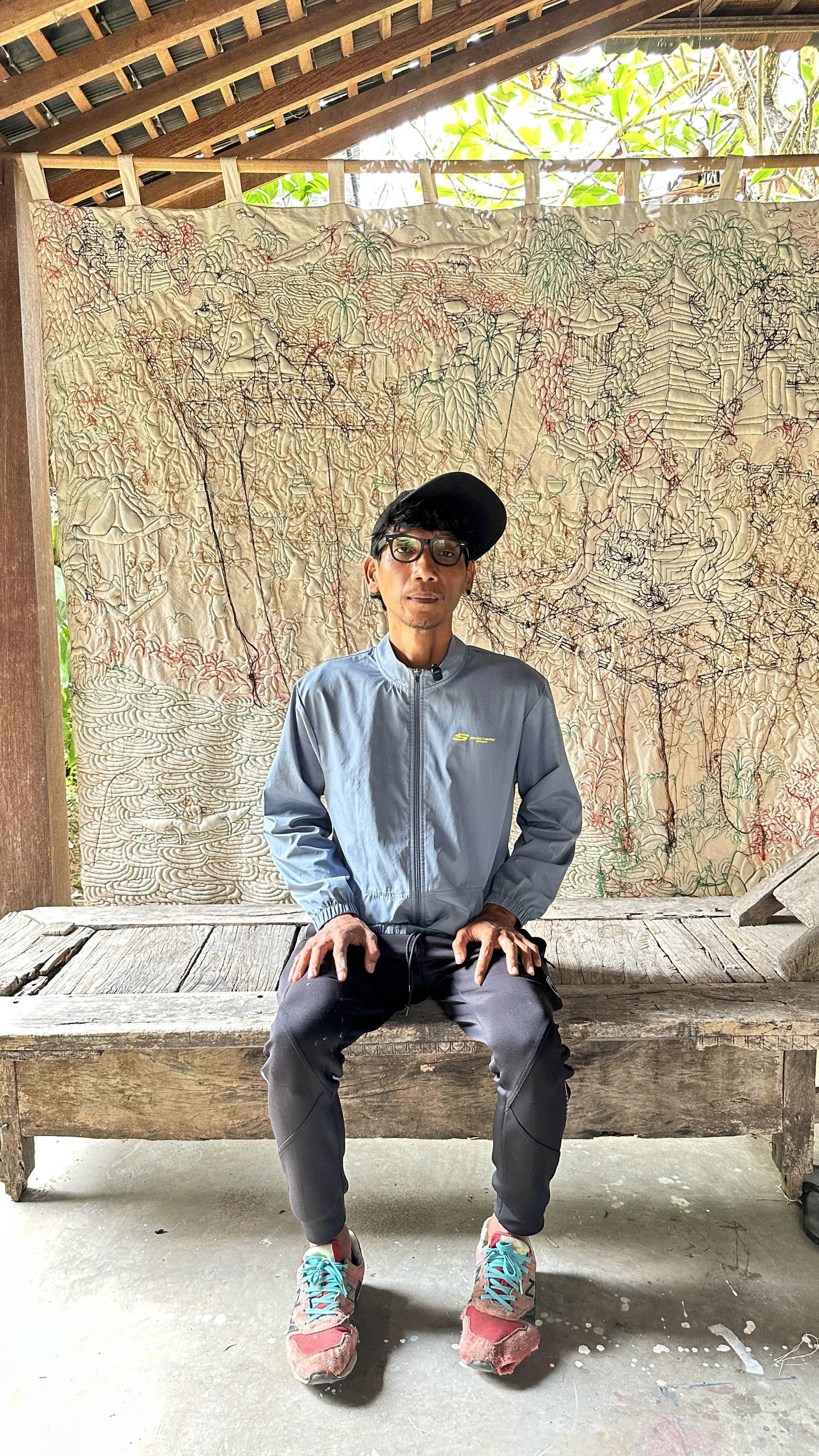
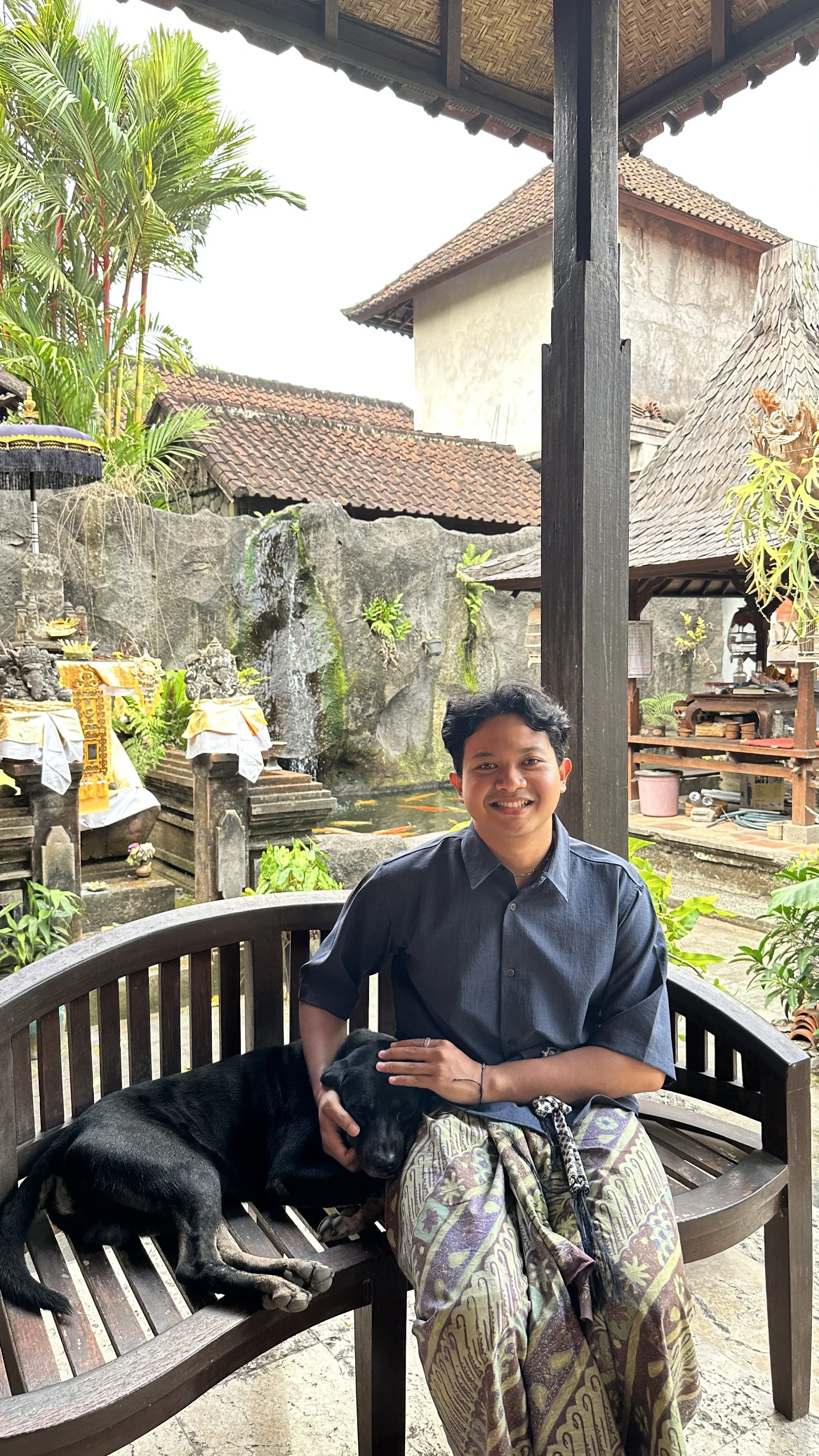
Ida Bagus Rekha is a young Balinese artist whose practice is rooted in Kamasan painting. He studied under I Nyoman Mandra, one of the masters of the tradition, and now explores Kamasan through everyday narratives, family identity, and printmaking techniques. His interest has also led him to investigate the legacy of his grandfather, Ida Bagus Made Gelgel, a Balinese painter known for his willingness to develop new themes and styles within the tradition of wayang painting. One of his works, Dharmaswami, is part of the collection at Museum Puri Lukisan.
For Rekha, looking back does not mean moving backwards. Tradition becomes a starting point for understanding the present, whether through inherited narratives or personal histories that have yet to be fully uncovered. In a conversation with Written, he discusses the connection between Kamasan painting and manga, his search for identity through his grandfather’s work, and his perspective on the expectations of cultural preservation often placed on young Balinese artists.
Rediscovering Family Traces
Written: You’re interested in both manga and Kamasan painting. Do you see a common thread between the two?
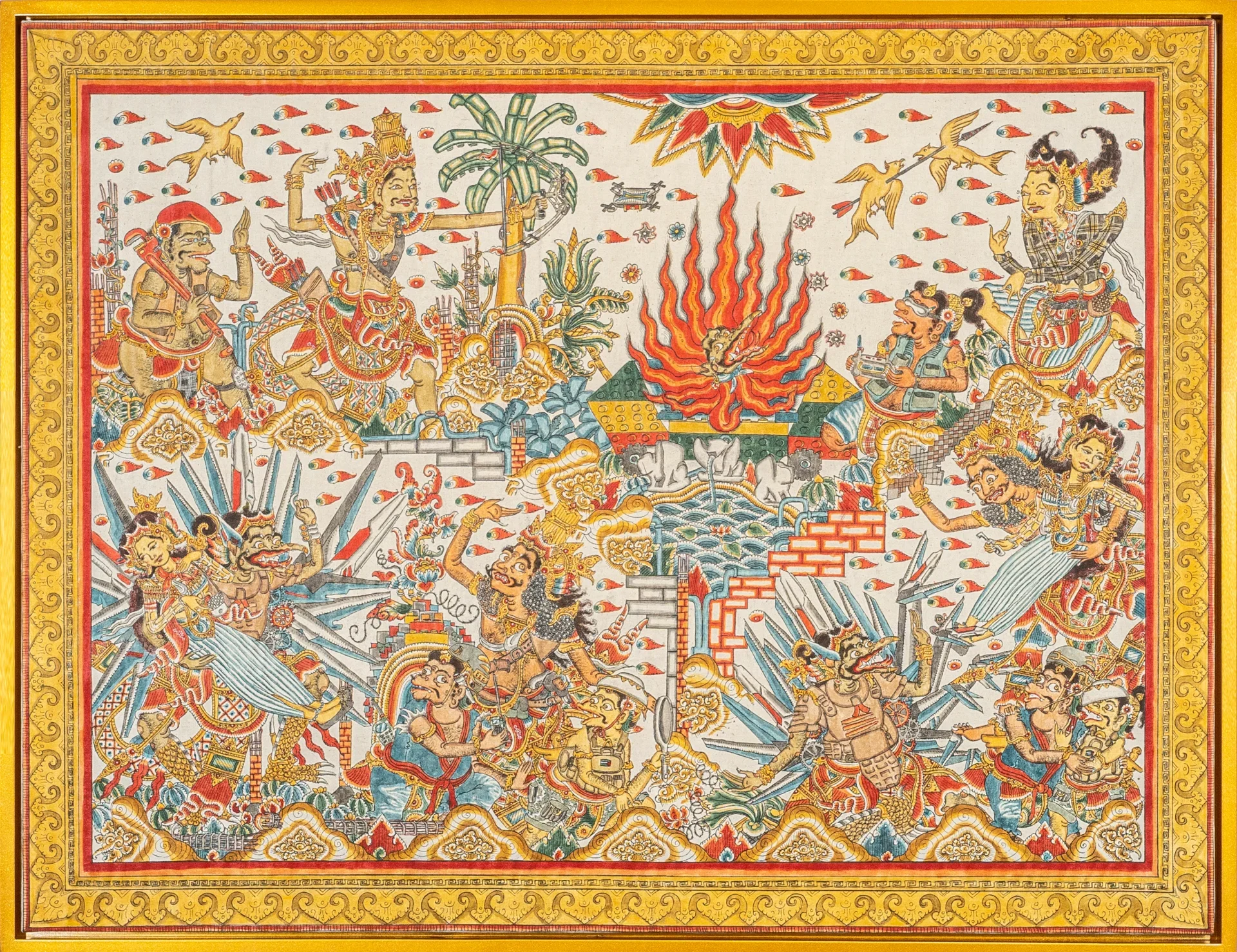
IB Rekha (R): Absolutely. In comics, we read stories panel by panel. Kamasan paintings can be read in a similar way. In long-format paintings that depict stories such as the Ramayana, for example, the narrative usually begins in the bottom-left panel, although the reading direction can vary.
Take the scene in which Rahwana attempts to abduct Sita. He disguises himself as a priest to trick her into leaving the protection surrounding her. In the next panel, Rahwana takes Sita away. The scene and situation change, and the story continues until, for instance, Jatayu attempts to rescue her. How far the story unfolds depends on the painter. Sometimes the narrative is cut short because the painter chooses to depict only one particularly iconic scene.
I only realized later that stories in Kamasan paintings do not always revolve around a single scene, unlike many paintings today that focus on just one subject. In Kamasan, the imagery can continue across the surface, much like reading a comic. There is a storyline, a sequence of scenes, and a plot.
Written: When you began exploring Kamasan, were there any traditional rules you felt should never be broken?
R: The clearest rule is that deities must not be depicted in ways that go against established conventions. Even in a contemporary context, deities cannot simply be used in Kamasan paintings in ways that deviate from those conventions.
I also feel that depicting deities in an irreverent context, regardless of the subject matter, is inappropriate. That makes sense because representations of deities in Kamasan painting are still used in everyday life, including in rituals. We also depict particular deities, such as Ganesha, for ceremonies in Bali. So, when a deity is portrayed in an irreverent context, it does feel inappropriate.
As for other aspects that might be open to reinterpretation, things remain somewhat ambiguous to me because I am not directly part of the Kamasan community. However, I once spoke with Mangku Muriati, who brings contemporary elements into her work, such as ambulances or people wearing masks. What she maintains, though, is the two-dimensional perspective characteristic of Kamasan painting. The imagery remains flat, without perspective, and uses colors typical of the tradition. She also does not depict deities in these everyday narratives.
From that, I understand that certain elements can be incorporated into artistic practice while still respecting the boundaries that exist.
Written: Beyond traditional themes, what do you explore in your personal work?
R: My themes vary quite a lot because I get distracted easily. I tend to make traditional works for temples or when someone specifically commissions a piece from me.
In my personal work, I enjoy depicting everyday stories, something like slice of life. Some works also explore questions of identity, particularly through my attempts to uncover my grandfather Ida Bagus Gelgel’s past.
My grandfather was a painter and one of the artists associated with the Pitamaha movement. His work is held at Museum Puri Lukisan. The problem is that I do not know much about him. Information about his life is limited, and not many people have written about him.
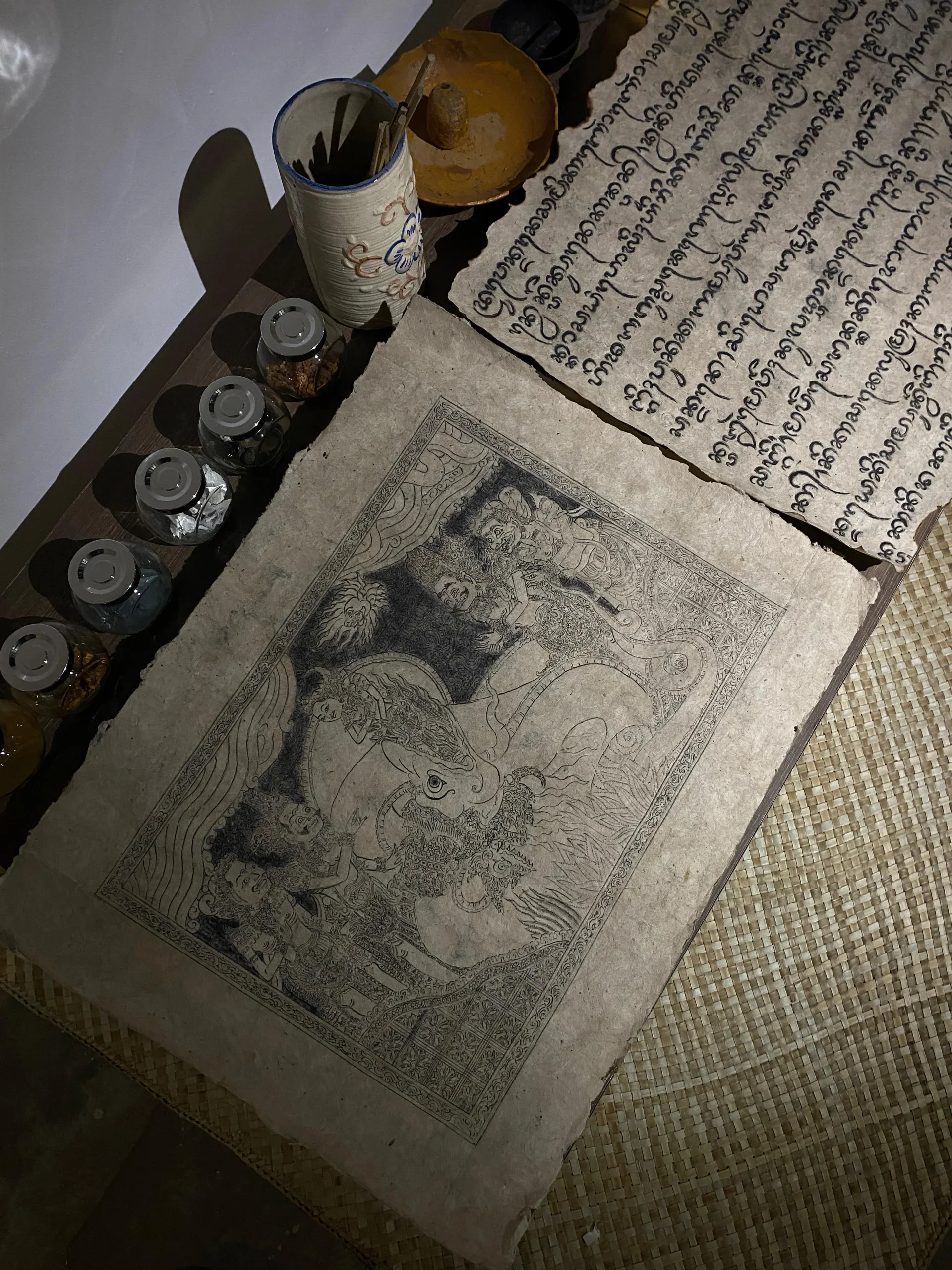
I started doing a little research by interviewing his younger sibling. From that, I created a work imagining what his final painting might have looked like. Many of his works were burned after he passed away as part of the Ngaben cremation ceremony. So, I tried to imagine his last work based on the information I managed to gather. I also incorporated several quotations from the interview and combined them with Balinese script.
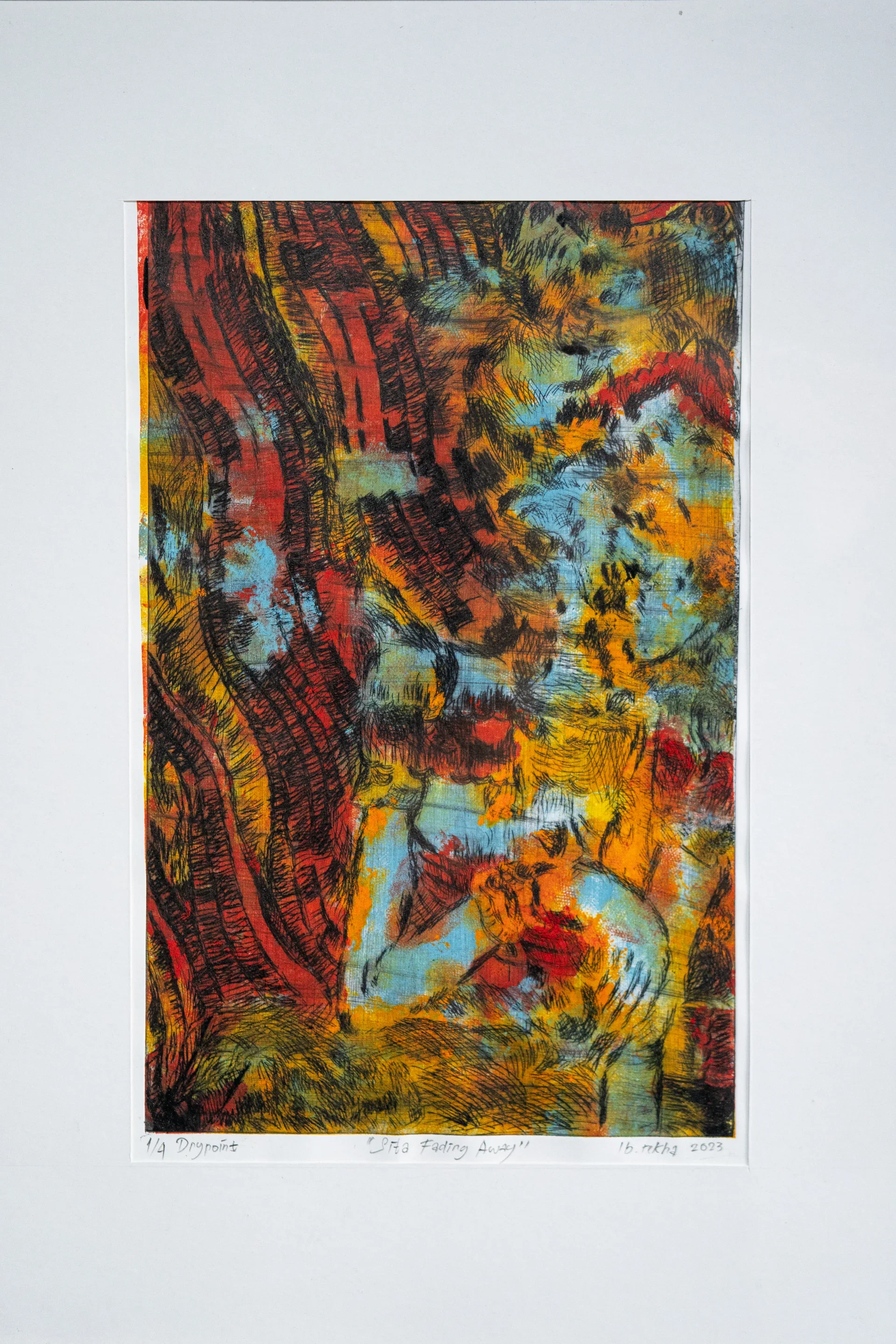
My exploration of Kamasan cannot be described as following a single classical style. I experiment with different approaches, including the dry point printmaking technique. One work began with an old painting at Museum Puri Lukisan that I noticed had deteriorated with age and was beginning to fade.
Through drypoint, I sought to capture the condition of the painting as it gradually faded. Indirectly, the narrative also relates to the story of Sita being consumed by fire. I found an interesting connection between the story itself and the physical condition of the painting as it slowly faded away.
Written: While many young artists are focused on looking ahead, why are you drawn to the past, even tracing your grandfather’s journey?
R: Perhaps after the pandemic, I had more time to be by myself and look back at my own journey. I began reviewing what I had learned.
While working on my master’s degree in fine arts, the story of my grandfather emerged because I felt that my family had a history connected to art. So, I started looking back, trying to understand a little more about him and other aspects of that history.
Indirectly, I began to realize that what happened in the past could happen again in the present or the future. I started seeing patterns, particularly through his works.
My grandfather had a painting titled The Death of Abhimanyu. Abhimanyu dies in battle, but the painting does not depict him fighting. Instead, it shows him after his death, surrounded by his family.
For me, the painting resonates strongly with the state of the world today, which is far from being in a good place. We live in a time when wars are still happening, and young people are often among their victims. I believe the painting remains relevant in a global context, even today.
That is why looking at history or the past is one way to learn. We can examine what happened before and apply what we discover to better understand the present.
Tradition Is Not a Burden of Preservation
Written: You also share your knowledge of Kamasan painting through Khatha Studio. What motivated you to do so after learning from Nyoman Mandra?
R: First, I do not work in the field of preservation or cultural conservation. So, I do not feel that I have a particular responsibility to continually develop or preserve this painting tradition.
However, because I once studied under Nyoman Mandra, I feel an inner urge to remember that he shared his knowledge with me, even though I was not from his village. In that sense, I was an outsider who came to learn, yet he still shared important knowledge with me.
That made me feel that passing on the same knowledge to others was perfectly reasonable, especially since he himself shared his knowledge with many people.
Of course, what I do is still very modest in scale. In Kamasan Village, there are structured studio-based learning systems and educational programs, whereas my activities are more introductory, a first step towards helping people become familiar with Kamasan painting.
Written: What kind of activities do you organise at Khatha Studio?
R: There are activities involving coloring and color mixing. For the color-mixing sessions, participants create their own mixtures and then use those colors to paint.
However, the activity I organize more often is coloring because it is easier. I prepare the sketches, then participants create the outlines and color them using the sigar warna technique found in Kamasan painting.
Written: As a young Balinese artist working with tradition, you are often expected to take responsibility for preserving culture. Does that label feel like a burden?
R: I see it as something I cannot really do much about. That label comes from the outside; it is not something we can fully control.
So far, when I speak with people from overseas or foreign visitors, they rarely see me as a cultural preservationist. They simply see me as a painter.
I offer them an art form with a history. But that does not mean my role is to introduce them to a particular culture or to become someone they can label as a cultural preservationist.
Perhaps we tend to see tradition here as something belonging to the past. Indirectly, we label it as old or irrelevant. There is also an expectation that tradition should remain in the form we recognize today.
I think the role of cultural preservationist needs to exist, but it should not be imposed on too many artists. If artists are continually burdened with that expectation, art can stop developing. In the worst-case scenario, tradition becomes stuck, and people lose interest in using it as a medium for their work because they feel they cannot express themselves within it.
The burden is there even before the creative process begins. You have not even started making a work, yet the pressure is already there.
Written: What do you think is the most common misconception people have when looking at traditional Balinese art, particularly Kamasan painting?
R: Perhaps it is the assumption that we have been doing the same thing since the sixteenth century. I do not think that is the case.
There are already many examples of artists using Kamasan in different ways, such as Mangku Muriati and Citra Sasmita. More recently, an increasing number of Balinese artists have been using Kamasan as a way to communicate their ideas.
I think the common misconception is that Bali only has an old tradition that is never reinterpreted. In reality, we can always use tradition as a way to move forward.
Drawing to Understand Oneself
Written: You have participated in several exhibitions. Is there a work that shows how you use Kamasan to tell personal stories?
R: I have not participated in dozens of exhibitions, and I usually take part in group shows. I have not yet had the opportunity to hold a solo exhibition.
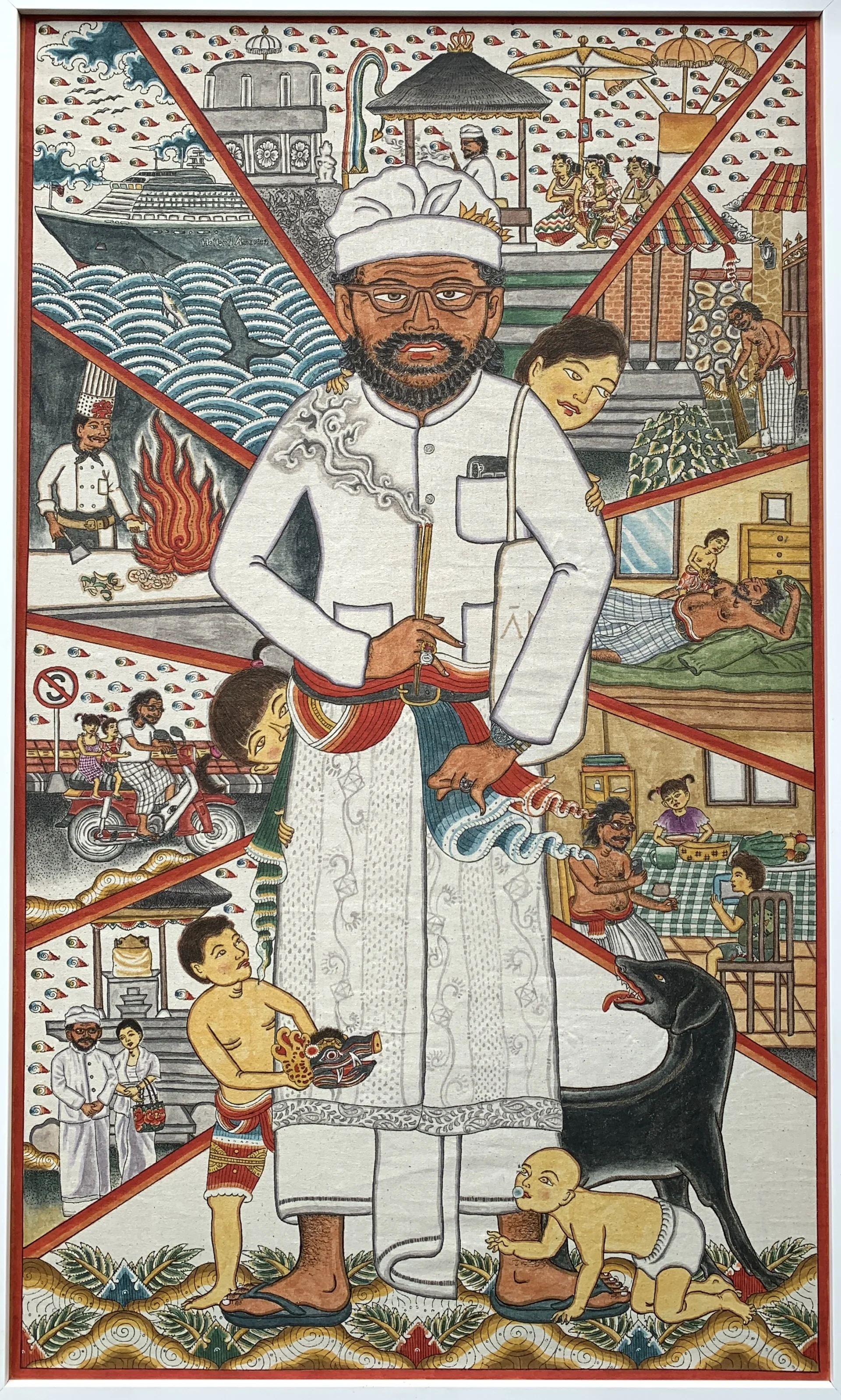
I once participated in an exhibition in Bali and received an invitation to exhibit in Bantul, Yogyakarta, through Le Gareca Space. The work I presented was also a Kamasan painting, but its story centred on my father’s life journey.
My father is now a mangku, a Balinese Hindu religious priest, but he had a life before becoming one. I depicted a single figure of him standing in the foreground, surrounded by smaller panels.
The story is a slice of life, showing moments such as taking his niece or nephew to school or working overseas in the past. It portrays my father as he continues to live his everyday life, even though he is now a mangku.
Written: If you were depicted as a manga character, which character would best represent you or your work?
R: Sai, a character from the manga Naruto.
I thought of him when I opened the PDF containing these questions and started imagining which character would suit me. Choosing someone too cool would feel unrealistic. Sai is a ninja who works in a covert unit, or black ops. He operates in secrecy and struggles with questions of identity.
I feel connected to this character because Sai tends to be emotionless or has difficulty expressing his emotions. He also uses drawings to fight his enemies. When he battles, he draws with ink on scrolls, and the drawings come to life.
I have only recently realized that I struggle to express my emotions. I often find it difficult to identify what I am feeling. You could say that my emotional library is a mess.
Even so, I try to channel those feelings into drawings and my artworks. These works are my attempts to express my anxieties and emotional states. So, perhaps we share the same approach: using images to communicate something that is difficult to express in other ways.