At the turn of the 20th century, Vitaly Komar and Alexander Melamid did more than paint. They dissected history through symbols, metaphors, and visual satire.
In the late 20th century, two Russian diaspora artists found themselves caught in the vortex of history and absurdity. Vitaly Komar and Alexander Melamid did more than paint. They dissected history, opening spaces long sealed by propaganda and collective silence.
From those cracks emerged frozen memories, transformed into symbols, metaphors, and visual satire. In their Nostalgic Socialist Realism series, the Yalta Conference, a major geopolitical event at the end of World War II, is brought back to life not through rigid documentation, but through vivid, poignant, and witty canvases.
When Aesthetics Meet Ideology
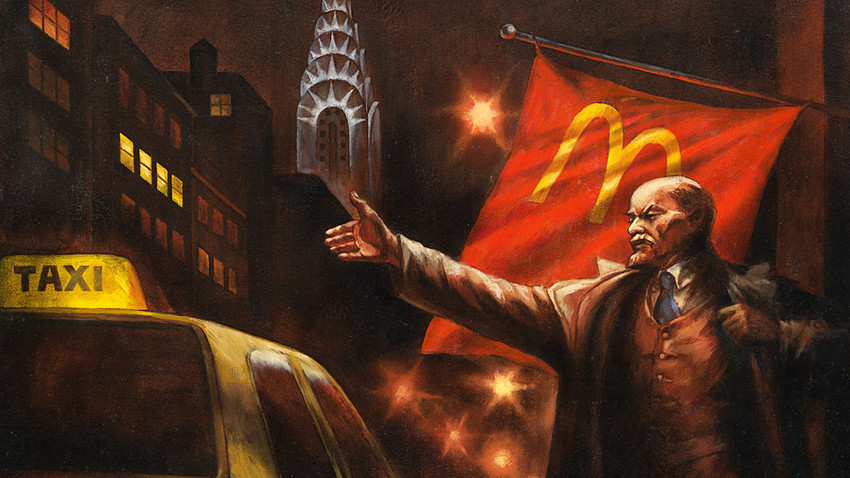
In the hands of Vitaly Komar and Alexander Melamid, art becomes more than mere form. It transforms into criticism, an alternative history, an interpretation that refuses to submit to the official version. The movement they pioneered, Sots Art, emerged as an act of defiance against the rigid and hegemonic Socialist Realism. If Soviet propaganda art was designed to reassure and persuade, their paintings instead provoke unease and doubt.
The three monumental works at the heart of this article are more than historical paintings. They are mosaics of collective trauma, political satire, and the search for identity. All three stem from the iconic photograph of the Yalta Conference, but are then twisted through imagination and critique, creating distortions that paradoxically bring us closer to the essence of reality itself.
Fragile Unity with E.T
In the first painting, the historical world becomes disoriented. Roosevelt is no longer a statesman, but an alien with the head of E.T., the cinematic figure from Steven Spielberg’s film that became a symbol of otherness and innocence in the 1980s. He appears between Stalin and, unexpectedly, Adolf Hitler, who peeks out from behind a red tent with a finger to his lips, asking for silence and reminding us of the silences embedded in official history.
The black that consumes the background creates a somber atmosphere, evoking the unhealed wounds of the World War. The red draped across the tent suggests blood and ideology, but also seriousness, belief, and perhaps deception. Through Barthes’ semiotics, the painting is rich with connotations. These are signs that transcend their forms, carrying meanings that can only be unlocked through experience and reflection.
Yet beneath it all, the painting is, in essence, a self-portrait of the artist. Komar, who grew up Jewish in Russia, viewed Roosevelt as “the foreigner” and, in turn, portrayed the alien as a mirror of himself: always on the margins, alienated by identity. Through E.T.’s face, he projects his own sense of alienation from official Soviet history.
A Game of Spheres
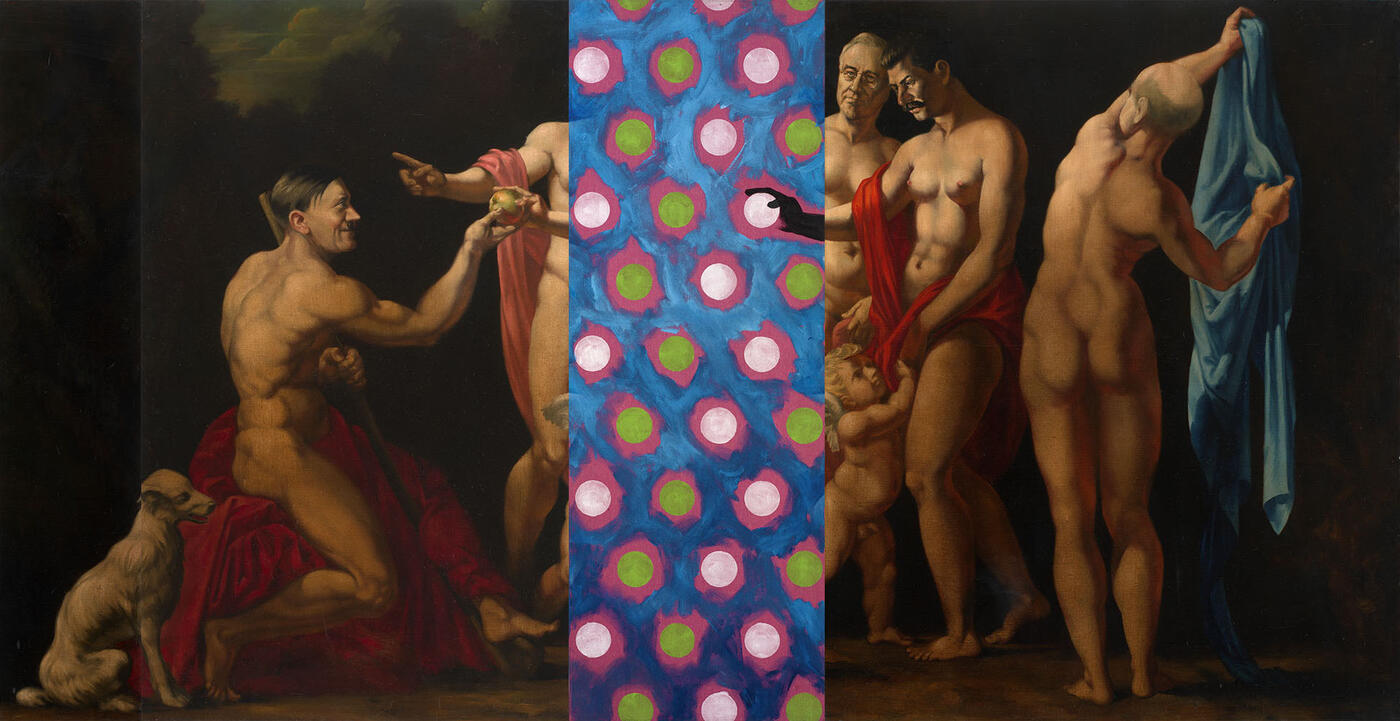
The second painting emerges as a metaphor for the game of power. At the center of the composition, an empty space cuts through the canvas, filled with small white and green balls, symbols of neutrality and peace according to Goethe’s theory of color. Roosevelt and Stalin discuss, pointing at and choosing among the balls. Hitler waits silently on the opposite side, while Churchill, draped in a calm light blue cloth, partially obscures the scene.
What is being chosen? What is being concealed?
Through Peirce’s semiotic interpretation, these balls become representamen, signs of decisions that were never openly declared. They are symbols of diplomacy unfolding amid a fog of intentions and illusions. The red cloth covering the main figures suggests seriousness, but also emotional deception. Meanwhile, the blue cloth held by Churchill represents a false sense of peace, concealing a darker reality.
Komar and Melamid do not make direct accusations. They play with the imagery, poke fun, yet never strip the event of its grandeur. Through visual language, they ask: who was truly making the decisions? And in whose name?
Divine Observers
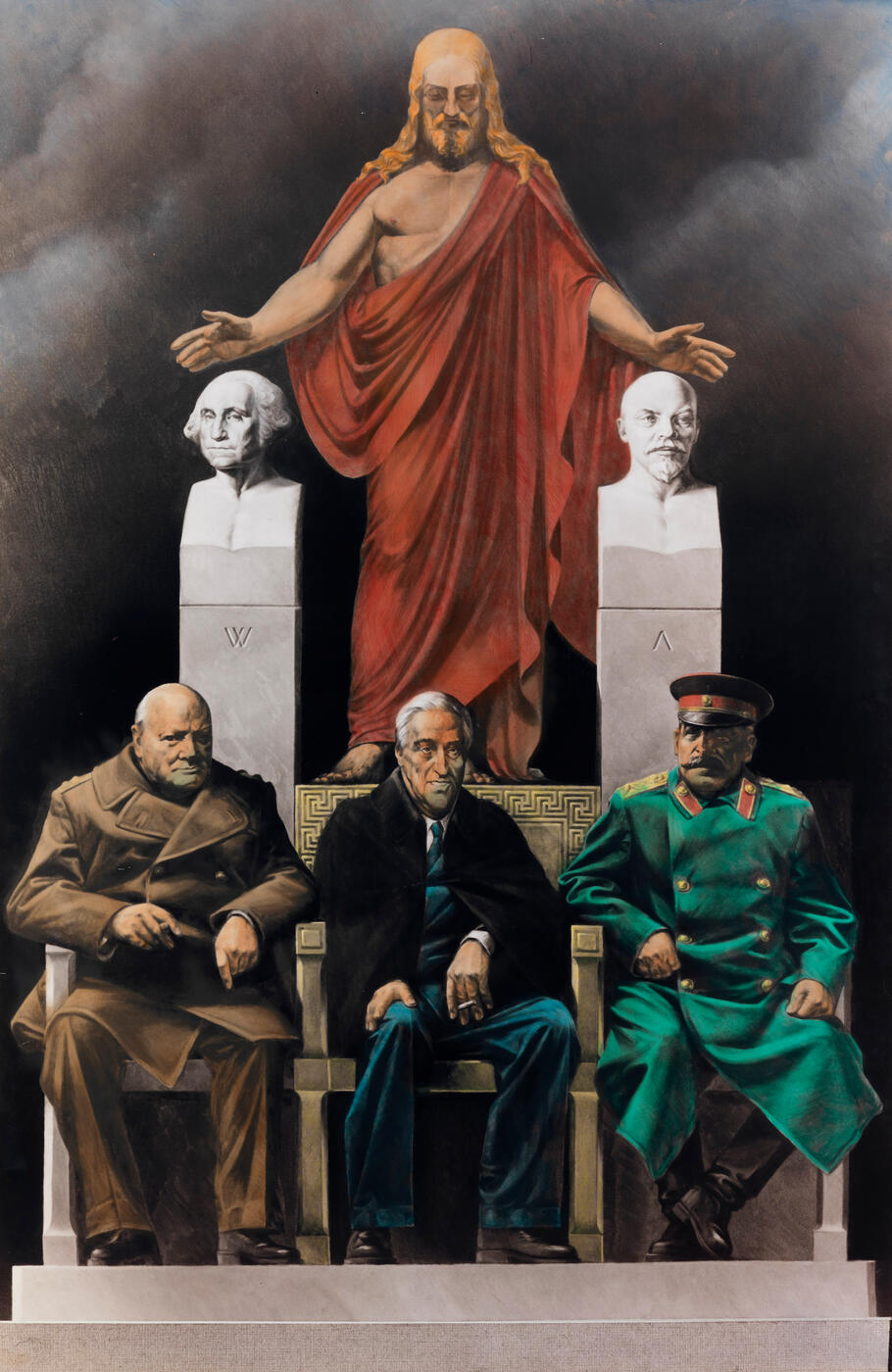
If the previous two paintings are allegories, the third is an altar. Rendered in a more realistic style, it recreates the arrangement of the three world leaders from the original photograph: Churchill on the left, Roosevelt in the center, and Stalin on the right. But something greater looms in the background.
Statues of George Washington and Vladimir Lenin stand firmly on either side, two ideological poles that divided the world. And at the center, the towering figure of Jesus Christ stands with open arms, watching over them, blessing them, or perhaps simply bearing silent witness. He wears red, the color of sacrifice, faith, and unseen power.
Gray smoke in the background symbolizes the spirits of war that have yet to depart. Black remains the emotional frame: depression, power, and fear. Through these symbols, we see not only the leaders themselves, but also the spiritual and political foundations that underpin them. Washington and Lenin, though long dead, remain alive through their ideas. And Christ, for the majority of people in all three nations, remains a moral point of reference, or perhaps a tool of spiritual legitimization.
The painting is a monument. It crystallizes the idea that great history is driven not only by human beings, but also by unseen forces: ideology, faith, and myth.
Between Nostalgia and Satire
The Nostalgic Socialist Realism series is an attempt to challenge a single, dominant narrative. Here, nostalgia is not about longing for the past, but a critical space for uncovering old wounds. Komar and Melamid play with elements of Dadaism, rejecting conventional aesthetics to convey something deeper: history is a game of signs, and we are its late-arriving readers.
Through these three canvases, the Yalta Conference is reframed as a universal drama: one of power, alienation, censored truths, and faith as either a shield or a pretext. With all their bitterness and boldness, Komar and Melamid invite us to look at history not from the podium, but from within the hidden spaces they reveal through art.