Starting with leftover fabric and discarded banners, Threadapeutic explores textile transformation through craft, experimentation, and collaboration. Founded by Hana Surya, the Jakarta-based artisan studio has grown to work with architects, interior designers, and product designers, while navigating the challenges of maintaining quality, embracing experimentation, and making the most of each material.
Everything in this world has to go through a process. Even the fabric we wear begins with something simple: a cotton plant growing slowly, harvested and spun into thread, then transformed into a material with a new form and meaning. But this time, we are not talking about cotton. We are talking about Threadapeutic, an artisan studio that extensively explores textile materials through its creative practice.
Threadapeutic's journey began in 2015 through a volunteer project at Indonesia Fashion Week (now Indonesia Fashion Chamber), where Hana Surya worked on turning discarded banners and leftover fabric into souvenirs. Since then, Threadapeutic has evolved to collaborate with interior designers and architects on a variety of projects. While the practice continues to evolve, its original thread remains clear: experimenting with fabric and manipulating it through the faux chenille technique to create tapestry works that have been exhibited both locally and internationally. This journey has also earned Threadapeutic two Design Anthology Awards for Textiles, in 2023 and 2025.
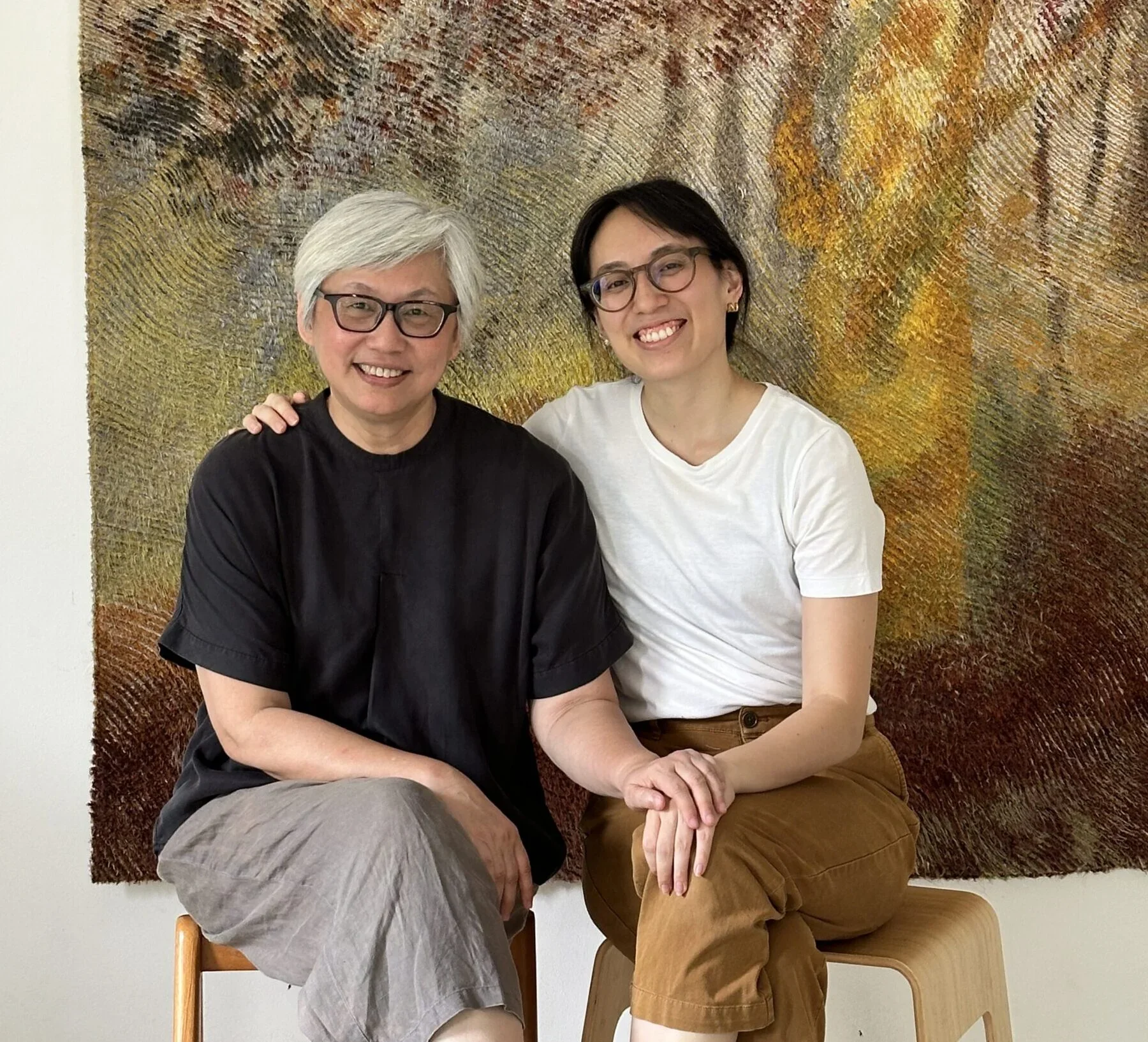
HAna (left) and Justine (right) – Threadapeutic
Perhaps all of this reflects Hana Surya's own language of love for textiles, which have been part of her life since childhood through her family environment—particularly her mother, who worked as a dressmaker specializing in evening and bridal gowns. More than that, however, Threadapeutic's journey shows how persistence, creativity, and the courage to keep experimenting can allow a craft practice to grow far beyond its original boundaries.
Written had the opportunity to visit the Threadapeutic studio in Pulomas, East Jakarta, and speak with Hana Surya (H), Founder, and Andriana Justine (J), Textile Artisan Apprentice at Threadapeutic, about the creative process behind their works and the challenges of working in the world of craft.
Here is Written's conversation with Threadapeutic.
Transformation and Collaboration at Threadapeutic
 Wall panel for Bank Jago. Courtesy of Threadapeutic.
 Details of wall panel for Bank Jago. Courtesy of Threadapeutic.
Written: When did Threadapeutic first begin collaborating with interior designers or architects on projects?
H: Our first project with an interior architect came after Maison & Objet in 2019. Budiman Ong introduced us to Budi Lim Architects. Then, in early 2020, he asked whether we would be interested in creating a 7 × 11-meter panel for a Bank Jago project. At the time, we were completely clueless because we had no experience making anything on that scale. There was also the anxiety surrounding COVID, our workspace, and limited manpower. But eventually, with the help of our partner, Surya Mandiri, a garment factory, we completed the project on time in three and a half months.
W: So when it comes to interiors, is it more about contributing to an existing project? What about working with product designers?
H: Our collaboration with product designer Studio Hendro Hadinata was one of the most memorable experiences for us, both as a learning opportunity and a collaboration. For the Road to Jia Curated 2025 exhibition, Budiman Ong, as curator and design partner, encouraged us to learn from and work with people from different disciplines who have different ways of thinking—from architects and interior designers to product designers.
 Pitta Stool, a collaboration between Threadapeutic and Studio Hendro Hadinata. Photo: Threadapeutic.
 Wall Panels, Bird’s Eye View. Courtesy of Threadapeutic.
Written: After 10 years, has the way you see your practice or your own expectations changed?
Justine: Two years ago, when Threadapeutic was approaching its tenth year, I asked Mama, "How are you feeling, what has changed?” She said that she now tends to feel more afraid and anxious. Before, we were only working for ourselves, so there was no pressure to make mistakes. It was all trial and error, just trying things out. But now, because we are increasingly working on B2B projects with architects and interior designers, we have to be extra careful throughout the production process, all the way to the aesthetics. So we tend to “play safe” and “meet deadlines”. These days, we actually feel more afraid to make something new, afraid that it doesn’t meet people’s expectations. But these opportunities to collaborate with other product designers have also given us new courage to experiment again, to try new things together.
Behind the Scenes: The Creative Process at the Studio

 Tapestry-making process. Courtesy of Threadapeutic.
Written: How do you control and maintain consistency at Threadapeutic so that the work stays top-notch?
H: It is actually about the basic things: the strength of the stitching, clean cutting, repeated brushing, and washing the fabric in between. The fiber needs to be brushed repeatedly until it develops that soft, fuzzy texture, working from the bottom layer to the top. This is a fairly lengthy process that requires time, patience, and persistence from the person doing the brushing. If the color arrangement does not turn out as intended, we repeat the process wherever necessary, from cutting all the way through to brushing.
Tapestry-making process. Courtesy of Threadapeutic.
Written: So there is a continuous process of refining. What are the parameters for finally deciding, “Okay, this is done”?
H: The pattern, flow, colors, and color gradations have to be what we envisioned. After the brushing, the stitches should still be tight, and the fibers need to be trimmed to the desired length so they do not tangle and are easier to maintain later on.
 Caterpillar Tray, a collaboration between Threadapeutic and Design by Weld. Courtesy of Threadapeutic.
Written: Does your approach to the material change depending on how the product will be used?
H: The treatment is different for a wall tapestry and for a chair. For a wall tapestry, if there are no specific requirements from the client, we can use coarser materials with a higher polyester content. What matters most is that the fiber colors match the request. But for products such as chairs that come into direct contact with our skin, we choose softer textile fibers such as cotton polyester or cotton. We prefer to make products where the fabric can be removed so it can be washed repeatedly. After repeated washing, the colors and textures will actually become more pronounced and softer.
 Lace Room Divider, a collaboration between Threadapeutic and Studio Hendro Hadinata. Courtesy of Threadapeutic.
Written: Once the work is installed on the wall as a panel, how is it cleaned?
H: Vacuuming. That is why we never make the fibers too long for panels, so they do not get pulled out. The maximum length is around 2 to 2.5 centimeters. It is essentially a way to make vacuuming easier, just like cleaning a carpet.
Perspectives on Material Use & Artisans
 Threadapeutic team. Courtesy of Threadapeutic.
Written: Is it difficult to maintain a supply of textile waste or leftover fabric?
H: If we really wanted to request larger quantities, it would actually still be fairly easy. But we are more focused on the craft itself than on simply processing waste. Rather than merely turning leftover garment-factory materials into something else, what we prioritize is the craft process, its strength, and our effort to achieve a high level of aesthetics.
Written: So the main challenge is not the material supply, but how to make the most of what is available?
J: Exactly. It becomes difficult when someone commissions a tapestry or a large installation and is very fixed on using a particular color. We don’t encourage that, because we prefer to explore what we can make the best of from the materials we already have. We often suggest that designers or customers who want to create something with us come to the workshop. From there, we can look at the process together and see how we can work with the colors.
 Forest Tapestry. Courtesy of Threadapeutic.
Written: So the spirit behind the practice is really about making use of the materials that already exist?
H: We do not talk much about sustainability, but we always try to make use of the abundant leftover materials we receive. Whatever is given to us and whatever we are able to accept, we try to make the most of it with the capacity we have, or by working together with others.
Written: And what about the artisans themselves? Working on textile craft like this can be quite complex and time-consuming.
J: Yes, brushing is the most time-consuming part of the process (for now) and requires much endurance, patience from the artisan. But it can actually be an enjoyable learning process, especially if you are trying to learn how to layer and compose your own tapestry. It’s the best time to learn how the colours from different layers of fabric come together. But it’s true this work is not for everyone. We try to look for individuals who already have an interest in hands-on craftsmanship, colour, texture… Otherwise it would just be suffering haha.
Written: So you really need to have an interest in it from the beginning, once you go through the process.
H: Actually, the craft we practice is not new. I think it is similar to how you approach any other craft. As Justine mentioned, ultimately, all you need is the willingness to learn, persistence, and a great deal of patience. The results of that precision and patience will always show in the end. Sometimes I feel that my background as a mother of three has trained me to be very, very patient, haha.
Curious about how this fabric manipulation process actually works? You can drop by and learn firsthand at the Threadapeutic studio. There, you can see the behind-the-scenes process of how Threadapeutic's works are made.